Tellus Science Museum makes a family day trip to Cartersville feel like several discoveries in one outing: prehistoric animals, colorful minerals, hands-on experiments, and a journey through the night sky. It is an appealing option for Georgia families who want an indoor destination with enough variety for different interests.
For a first visit from Kennesaw, Marietta, or Atlanta, the most useful planning tip is to check activity times before setting your schedule. The museum can be open while fossil digging and gem panning have not started yet, and planetarium shows need their own tickets.
Watch the Tellus Science Museum video
Tellus Science Museum tickets, hours, and location
| Detail | What to know |
|---|---|
| Address | 100 Tellus Drive, Cartersville, GA 30120 |
| Regular hours | Daily, 10 a.m.–5 p.m. |
| Holiday closures | New Year’s Day, July 4, Thanksgiving Day, and Christmas Day |
| Adults | $20 |
| Children, ages 3–17 | $16 |
| Students with ID | $16 |
| Seniors, ages 65+ | $18 |
| Parking | Free |
| Phone | 770-606-5700 |
These are the museum’s published general-admission rates. Check current conditions before purchasing. The official FAQ confirms free parking, and the museum is reached from I-75, Exit 293.
The official ticket portal recommends advance admission tickets but does not require them. Tickets are valid for the date selected; workshops, school or scout programs, and certain special events are separate.
A sample family budget
For two adults and two children aged 3–17, standard admission totals $72. One $5 planetarium show for each of those four visitors brings the total to $92, before food, shopping, or any checkout charges. Fossil digging and gem panning do not add a separate activity fee when included with general admission.
Choose the extras around what your family actually wants to do. A visit centered on fossils and hands-on activities can be a full outing without trying to attend every available show.
Start with dinosaurs and the Fossil Gallery
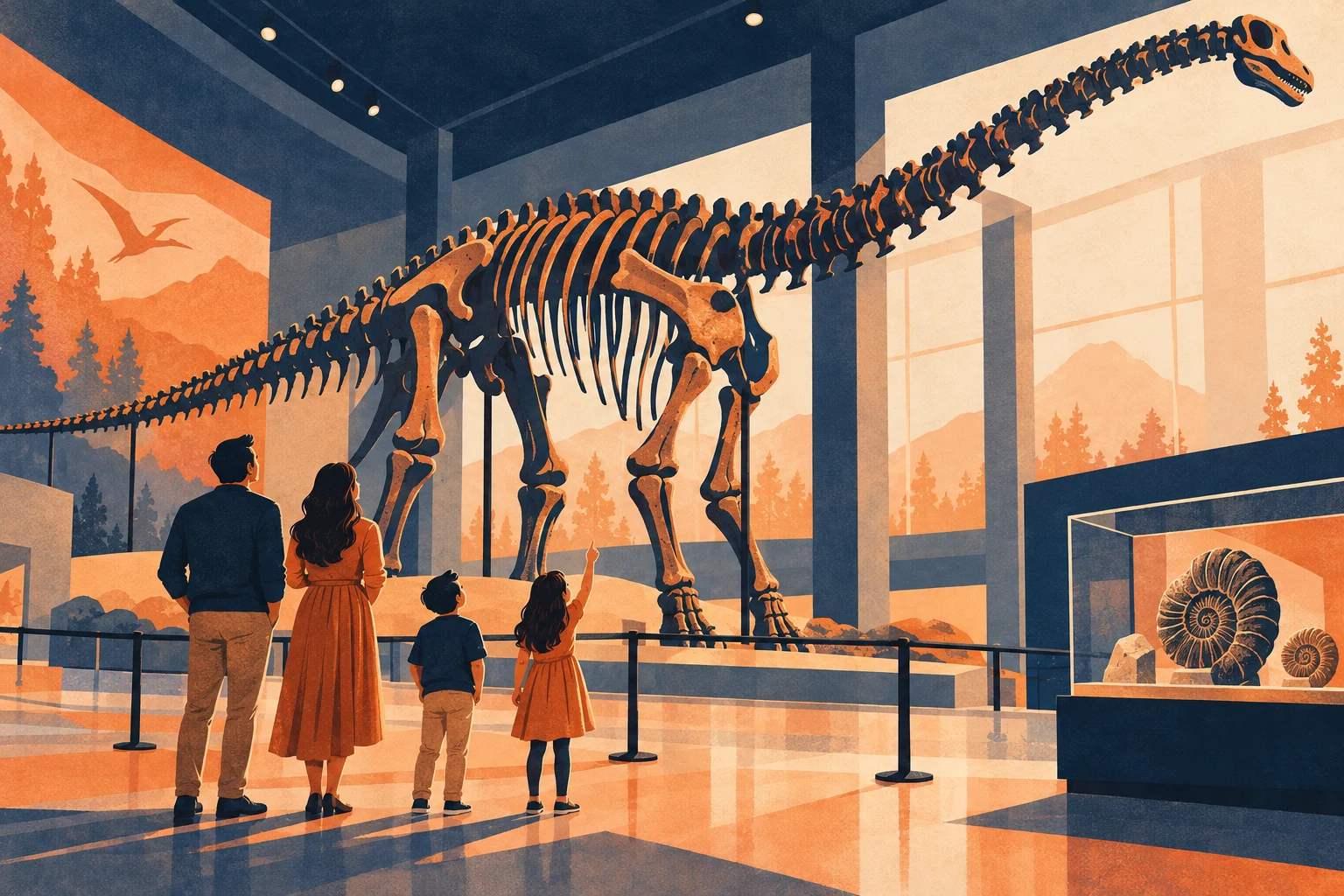
The Fossil Gallery includes a Tyrannosaurus rex display, a saber-toothed cat, and a nine-foot-wide megalodon jaw. Its Georgia-underwater section connects prehistoric life to the state around us.
For children, start with size and shape before worrying about names. Compare teeth, look at how different animals moved, and ask what clues a skeleton gives us. Let each person choose one specimen to investigate instead of trying to read every label in order.
Our suggestion is to visit this gallery before the Fossil Dig. Seeing the larger displays first gives children something to connect with when they begin looking for smaller finds.
Minerals, inventions, and experiments
Weinman Mineral Gallery
The Weinman Mineral Gallery explores gems, minerals, and the processes that shape Earth. Highlights include fluorescent minerals and a seven-foot copper boulder.
Try comparing two samples by color, texture, or crystal shape. Ask children to choose a favorite before looking at the name, then see whether anything about it surprises them. It is a simple way to turn a display case into a conversation.
Science in Motion
The Millar Science in Motion Gallery follows changes in transportation, from early automobiles to space travel. The museum describes electric, steam, and gasoline-powered vehicles alongside space-related displays and replicas.
This is a good stop for visitors who are more interested in machines than fossils. Compare what people wanted to achieve with the technology available to them, then think about which everyday inventions might look unusual to a future museum visitor.
My Big Backyard
Collins Family My Big Backyard focuses on learning through experiments with light, sound, magnets, and electricity. Younger children also have activities such as sorting and raceways.
Leave room for repetition here. A child trying the same experiment several times may be testing an idea, even if the rest of the group is ready to move on. A flexible pace often works better than a checklist of rooms.
Fossil Dig and Gem Panning: check the hours
Both activities are included with general admission. The dedicated activity page lists these hours:
- September–May weekdays: noon–5 p.m.
- September–May weekends: 10 a.m.–5 p.m.
- June–August: 10 a.m.–5 p.m. daily.
At the Fossil Dig, children brush through sand and can select one favorite small fossil to keep. Gem panning lets them sift for stones to take home. The museum provides downloadable identification sheets for both activities.
For an October weekday visit, start with galleries and plan these activities after noon. Before leaving each station, help children secure their souvenirs so a tiny find does not disappear into a coat pocket or onto the floor.

Adding a Bentley Planetarium show
The Bentley Planetarium costs $5 per show for non-members with museum admission. The museum lists a $4 member rate. A planetarium ticket does not replace general admission.
There is a difference between the museum’s general information and its current booking portal: the information page says to buy at the admissions desk, while the ticket portal specifies same-day desk purchases for weekdays and offers online weekend planetarium tickets. Check the portal for your date and call if a particular show is essential to your visit.
October 2026 show ideas
The schedule posted for September 26–October 31 includes Spooky Space, recommended for ages 6+, and Halloween: Celestial Origins, recommended for ages 8+. It also includes a live night-sky presentation and Spark: The Universe in Us.
Use the official schedule for exact times and age recommendations; availability can change. Choose a show that suits your children’s interests and comfort with a dark theater, then build the rest of the visit around that time.
Visiting October 3–4? Check this admission benefit
The museum lists October 3–4, 2026 as its next Museums on Us weekend. Under the published program rules, eligible Bank of America or Merrill Lynch credit or debit cardholders receive one free general admission when presenting their valid card and photo ID.
The benefit is for the cardholder only. It does not automatically admit their spouse or children, and it excludes planetarium shows and ticketed special events. Calculate the cost for each person in your group before assuming the whole visit is free.
A relaxed plan for your first visit
- Choose a priority before leaving. Ask each family member whether fossils, minerals, experiments, or space interests them most.
- Check show tickets on arrival. If attending the planetarium, settle that time before wandering through the galleries.
- Explore two galleries at your own pace. Stop for the displays that spark questions instead of racing through all four.
- Take a lunch break. Then add fossil digging and gem panning when open.
- Finish with one favorite. Revisit an experiment or choose a final gallery rather than stretching the day past everyone’s energy.
The museum’s planning page recommends at least three hours for a typical walk-through, before adding a planetarium show or outdoor trail. Our suggestion is to leave a flexible half day. Check traffic from your starting point and avoid a tightly timed second attraction.
Food, accessibility, and practical tips
The Tellus Café lists daily hours of 10 a.m.–4 p.m., with meals, snacks, and drinks. Outside food and drink are not allowed inside the museum; the FAQ identifies an outdoor picnic pavilion as an alternative.
Tellus describes its museum building as one level, with a ground-level entrance and no steps to exhibits. Strollers are permitted, wheelchairs are available first come, first served, and a Quiet Room offers a place for sensory relief. Ask Guest Services about specific needs.
Children under 16 must be accompanied by an adult. Pack lightly and check the visitor policies before bringing bulky items. Follow exhibit signs about touching and photography.
Questions before you go
Is Tellus only for young children?
No. Our suggested approach for adults is to give more time to the collections, transportation history, or a planetarium presentation. Families can mix those stops with the interactive areas.
Can you visit Tellus and the Booth Museum in one day?
You could plan both, but we recommend separate outings for a first family visit so neither feels rushed. Read our Booth Western Art Museum guide and choose the one that best matches your group’s interests.
What other Georgia outings should we try?
For more transportation history, see our Delta Flight Museum guide. For an outdoor day, explore Sweetwater Creek State Park.
Visitor information checked October 1, 2026, against official Tellus sources. Rates, schedules, and availability can change. This is a researched planning guide, not a firsthand visit report. All images are AI-generated conceptual illustrations, not documentary photographs or exact exhibit reproductions.